
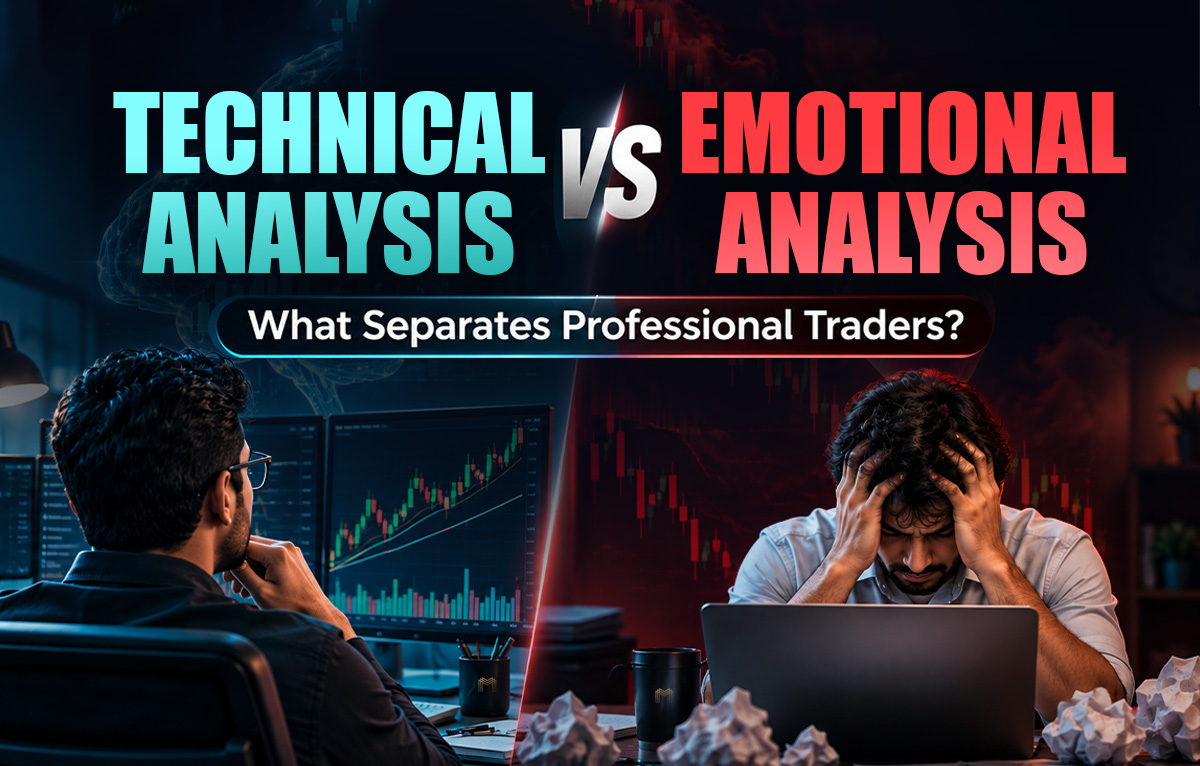
What Separates Professional Traders?
What separates professional traders from beginners comes down to three mindset shifts — what they follow, how they prepare, and how they decide. Each one looks small on its own, but together they explain why one trader reacts and another simply decides. Here’s what they actually do differently.
1. They Follow Money, Not Candles
“You don’t chase the candle. You follow where the money was already flowing before the candle formed.”
An amateur looks at a chart and asks, “Which stock is moving?” A professional asks a different question entirely: “Where is capital moving, and why?” That single shift in the question changes everything downstream.
Money behaves like water — it always flows toward the path of least resistance, toward wherever demand is building. A professional tracks this at a global level first: why uranium or thorium is suddenly attracting capital, which industry is benefiting from a policy shift or a supply shortage. Only after understanding where the water is flowing do they narrow down to a specific stock within that industry.
On the other hand, an amateur skips straight to the candle and misses the story behind it entirely.
- Amateurs react to price movement; professionals investigate the capital flow that caused it
- Global demand shifts, policy changes, and supply constraints show up in capital flow long before they show up on a chart
- Knowing why a stock is moving is what allows a professional to trust the move — or ignore it
2. They Build Depth, Not a Watchlist of Everything
“Nobody wants a general opinion on a heart problem. Why would you want a general opinion on where to put your money?”
An amateur follows 50 stocks across every sector, hoping one of them moves in their favour. A professional knows 2 or 3 sectors deeply enough to recognize a genuine opportunity the moment it appears. This is no different from medicine — a general physician knows a little about every ailment, but a specialist who has spent years going deep into one system earns the trust to make complex calls a generalist simply isn’t equipped to make.
The same logic applies to markets. A trader who deeply understands a couple of sectors builds pattern recognition an amateur spreading thin attention across fifty tickers never develops.
- Depth in a few sectors builds pattern recognition that breadth across many never can
- A trader who knows a sector’s normal behaviour can tell genuine momentum from a temporary spike
- Following everything usually means understanding nothing well enough to act on with confidence
3. They Follow a Process, Not a Feeling
“Emotion asks, ‘What if I miss this?’ Process asks, ‘Does this actually qualify?’ Only one of those questions should decide a trade.”
An amateur decides based on FOMO, fear, and whatever the latest candle is doing. A professional runs every decision through a process — fundamentals, capital flow, technical confirmation, and predefined rules, in that order. This is the real dividing line between technical analysis and emotional decision-making. It isn’t that professionals never feel FOMO or fear; it’s that they’ve already decided, in advance, that feelings don’t get a vote in the decision.
- Amateurs let the last candle and their emotions make the call in the moment
- Professionals combine macro understanding with technical confirmation — like MMM’s TLS framework — before ever entering a trade
- A predefined process removes the question “what should I do right now?” because that question was already answered in advance
Bringing It Together with MMM
Over 17 years in the markets, the traders who consistently survive are never the ones reacting fastest — they’re the ones who follow money instead of candles, go deep instead of broad, and trust a process instead of a feeling. At Mithun’s Money Market, our varied training programs – both group and personal – offered in Dubai and Abu Dhabi are built to install exactly these three shifts — the same three that separate every professional trader from a beginner still guessing.
FAQs
No — professionals combine technical analysis with fundamentals and capital-flow awareness, not technicals in isolation.
It varies, but it’s built through consistent, disciplined practice over time, not through reading or theory alone.
They treat it as a probability outcome within their process, not a personal failure, and move to the next setup.
That professionals never feel fear or FOMO — the real difference is they don’t let those feelings decide the trade.
No — it improves the odds of a sound decision, but no single factor can guarantee any individual trade’s outcome.